Bond Settlement Cut from 2 Days to 30 Minutes
97%
Less bond settlement time67%
Less time to market0
Coupon calculation errors
Client Overview
Business Problem
Situation Before
Core Pain
Risks
- The bank could not grow its corporate bond market without automating the full instrument lifecycle.
- Possibility of regulatory issues because of incorrect or untimely payments to investors
- Inability to increase issuance volume without expanding back-office staff proportionally
- Lack of investor trust due to no real-time visibility into interest calculations
Constraints
- The MVP launch date was tied to regulatory deadlines and to the dates of live bond issuances.
- Calculations had to comply with local financial legislation, which required up to 8 decimal places.
- Portions of the logic had to integrate with existing core banking systems through message buses.
- Domain complexity was high: business day calendars, interest conventions such as Actual/365 and multi-stage lifecycle state.
Project Goals
- Launch a modern, compliant corporate bond market for the bank's institutional and retail investor base
- Eliminate manual processing errors in investor payments
- Reduce time-to-market for new bond issuances
- Improve investor transparency through real-time visibility into interest calculations
- Create a distributed, modular financial platform that can handle high-volume allocation events
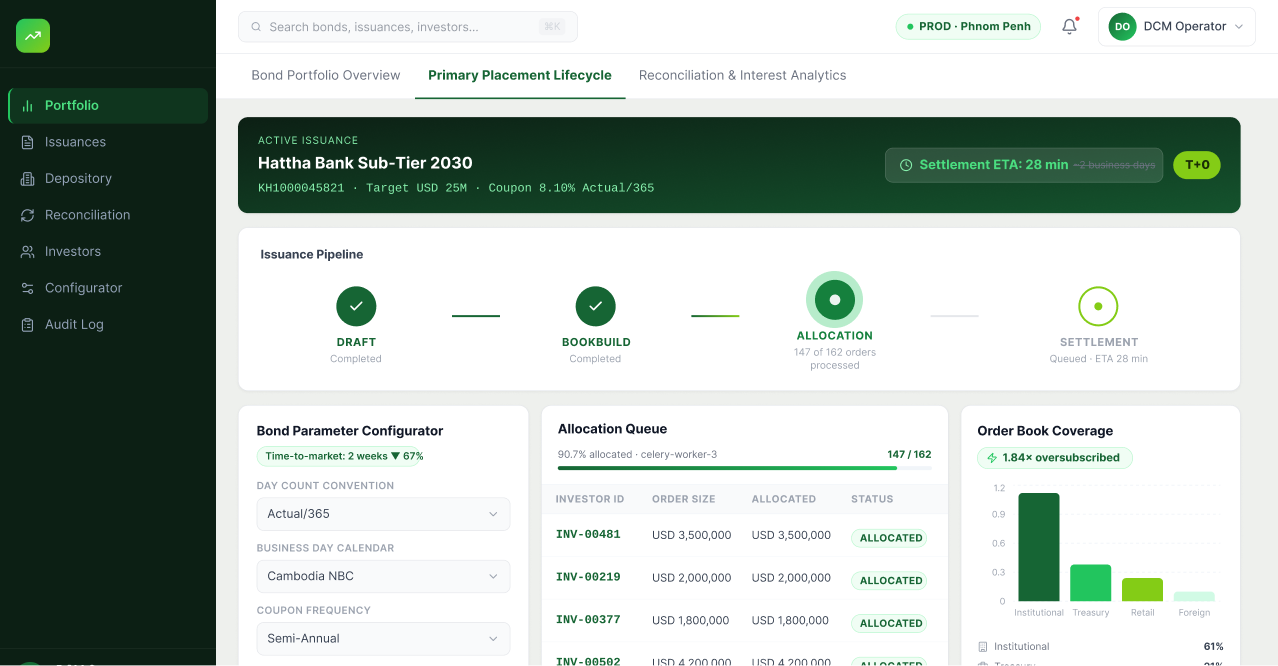
- Develop a dependable state machine tracking the full primary placement lifecycle (draft → bookbuild → allocation → settlement)
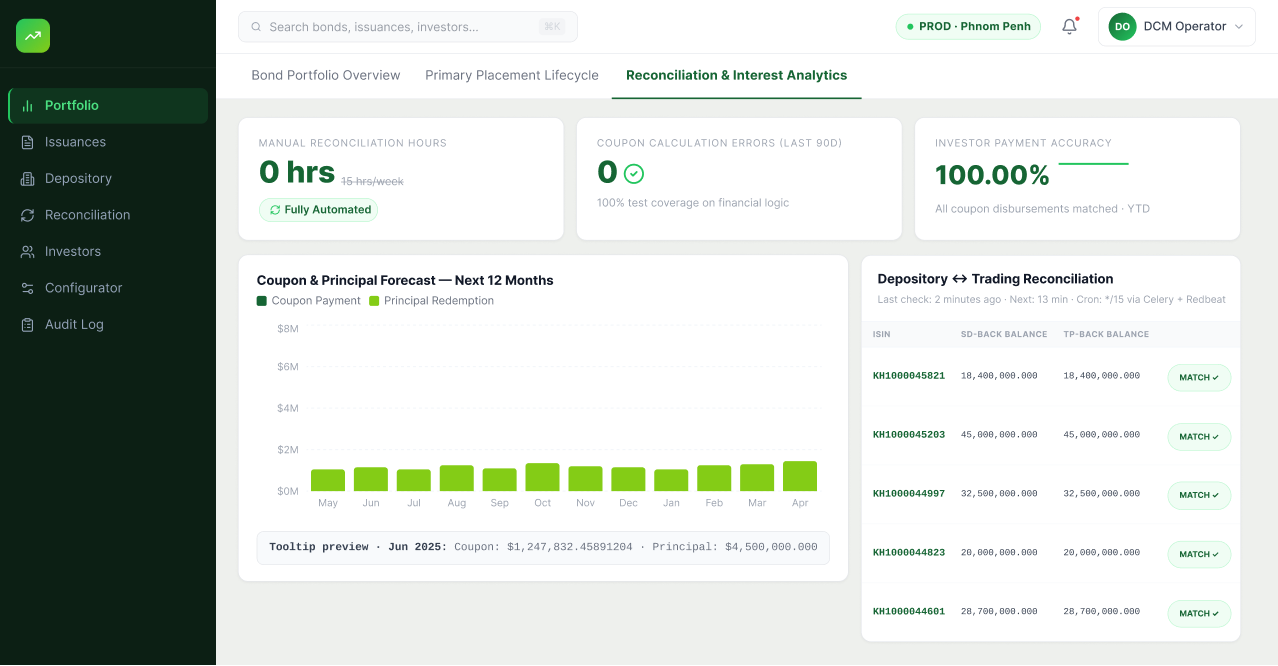
- Automate coupon and principal repayment calculations with 100% test coverage
- Set up automated reconciliation to ensure data accuracy between the depository and trading services
- Connect with the bank's existing IAM and core banking infrastructure
- Settlement time reduced from 2 business days to under 1 hour
- Zero errors in coupon calculations post-launch
- New issuance preparation time reduced to 2 weeks or less
- Automated reconciliation replacing manual back-office checks
Solution
The system employs a service-based design, comprising two separate services that can be deployed independently: the Settlement Depository (sd-back) and the Trading Platform (tp-back). The two services exchange data over REST, while a REST API layer powers the mobile apps and the admin panel. Django forms the core framework of the application, and FastAPI hosts the high-throughput components. A state machine controls the primary placement lifecycle, bringing an issuance from "draft" through "bookbuild" and "allocation" to "settlement". Both services were designed and built by Pynest.
Pynest created the Interest Calculation Module to calculate coupon and principal payments from business day calendars and configurable rules, forecasting future payments rather than calculating them after the fact. The Primary Placement Module executes issuance through step-by-step rule checks, while background processes handle fund allocations so the system stays responsive under many orders. The Reconciliation Module matches depository and trading data automatically. The Bond Parameter Configurator lets users change interest calculation rules and bond parameters without modifying the code.
Docker is used for containerization, meaning that a service behaves in the same manner on both the developer's machine and the production environment. The automated deployment pipelines are executed using GitLab CI/CD. For distributed task scheduling and the recurring financial jobs that the platform triggers according to its calendar, Celery with Redbeat is used. Gunicorn is the WSGI server behind the Django application. UV is used for dependency management, and ruff for code quality enforcement.
The system interfaces with the bank's IAM system for identity and access management. Multi-level access control and investor data isolation are enforced at the application layer so that one investor cannot see another investor's data. All transactions go into a full audit log, and settlement instructions are signed. Calculations comply with local Cambodian financial legislation, which requires up to 8 decimal places, so the system runs high-precision decimal arithmetic.
Key Steps
Pynest engineers joined the client's delivery structure under a team augmentation model and ran an audit of the codebase. The team captured requirements with the client and configured Jira. The work has run on Agile Scrumban with weekly sprints from day one, inside the client's own ceremonies and tooling: Jira, GitLab, Microsoft Teams, with mandatory code review on every feature.
Pynest built the two services that carry the platform, the Settlement Depository and the Trading Platform, and wired them together over REST. The Interest Calculation Module, the Primary Placement Module with its stage-by-stage rule checks, the Reconciliation Module and the Bond Parameter Configurator all came out of this window.
The platform went live and processed its first bond issuances inside the MVP window, tied to the regulatory launch dates the project had been planning around. Settlement time and error elimination showed up as measurable gains from first production use, not months later. The client accepted the release.
After the MVP launch and the first live issuances, the client expanded scope to additional bond instrument types and to stronger reporting in the administrative panel. Backend team capacity was reviewed to support parallel development of new modules, among them the buyback lifecycle and secondary market features.
Pynest keeps improving the product and is integrating the platform into other services' flows. The bond parameter configurator takes new instrument types without rewrites of core logic, which is what keeps the roadmap open toward secondary market automation and further core banking data sources.
Results & Impact
Project Snapshot
See Other Works
Secure LLM Gateway for a 63,000-Person Enterprise
Secure enterprise AI access with centralized governance, lower latency, content controls, and full token usage visibility

API Response Time Down 80% for a Bloomberg Rival
Financial analytics platform delivering real-time market data, news processing, and scalable backend services for fintech
Power Station Analytics: Algorithm Suite Delivered
Real-time equipment analytics platform for a power station with automated calculations, monitoring, and reliable fault detection